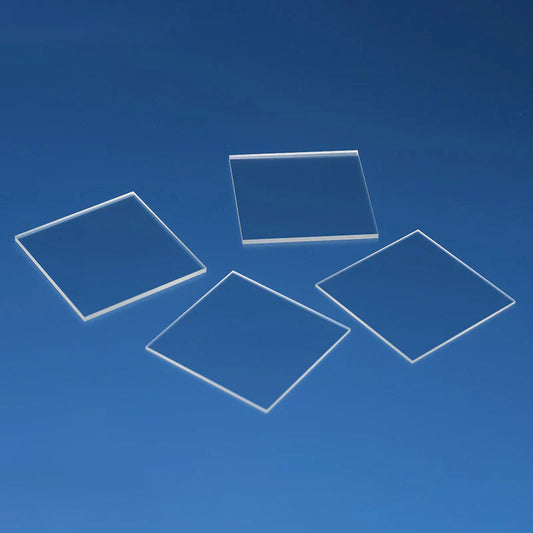
Form factor
Choose plate, wedge or cube construction from beam displacement, ghost-reflection control and mounting space.


PRODUCT FAMILY
Plate and wedge beamsplitters provide low-mass beam division with flexible aperture and coating options.
Polarizing, broadband, elliptical and infrared families allow selection around incidence angle, ghost suppression, material and reflected-to-transmitted power ratio.
SELECTION PRIORITIES
7 product families are available. Use the engineering filters below to narrow the catalog before comparing exact models.
Choose plate, wedge or cube construction from beam displacement, ghost-reflection control and mounting space.
Define the reflection-to-transmission ratio and whether polarization separation or non-polarizing behavior is required.
Verify the coating band, design angle, clear aperture and wavefront specification for both output paths.
PRODUCT FINDER
Compare product families, then open a family to select the exact model, dimensions and coating.
Try another keyword or clear the search field.
SELECTION QUESTIONS
Technical answers to the questions that most often affect model selection.
Send your material, wavelength, dimensions and quantity for review.