
OPTICAL COMPONENT CATEGORY
Beamsplitters
Beamsplitters divide or combine optical power for interferometry, imaging, illumination, polarization analysis and multi-detector systems. This category includes plate and wedged beamsplitters for low-mass beam division, compact cube beamsplitters, polarizing designs that separate s and p states, and non-polarizing or broadband designs intended to maintain a defined reflection-to-transmission ratio over a specified wavelength region.
Start with wavelength, nominal splitting ratio and polarization behavior, then choose a geometry that fits the permitted beam displacement, ghost-reflection level and mounting space. Confirm angle of incidence, clear aperture, transmitted and reflected wavefront, coating orientation and substrate. A wedged plate helps separate secondary reflections, while a cube simplifies orthogonal path alignment but introduces additional glass path length. Model tables provide the exact dimensions, coating band and ratio specifications available for each family.
BROWSE BY OPTICAL FUNCTION
Choose a product family

Cube Beamsplitters
4 product familiesCube beamsplitters divide an incident beam at an internal coated interface while keeping transmitted and reflected paths mechanically compact.
Browse family →
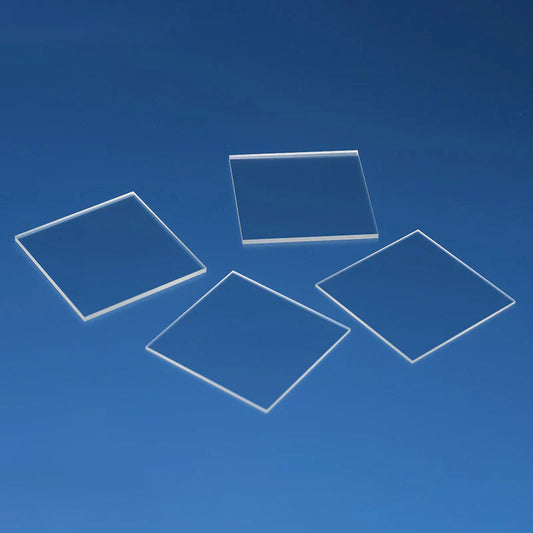
Plate & Wedge Beamsplitters
7 product familiesPlate and wedge beamsplitters provide low-mass beam division with flexible aperture and coating options.
Browse family →PRODUCT FINDER
Beamsplitters
Compare product families, then open a family to select the exact model, dimensions and coating.
11families found


No matching product families on this page
Try another keyword or clear the search field.
SELECTION QUESTIONS
Beamsplitters FAQ
Technical answers to the questions that most often affect model selection.
How do plate, wedge and cube beamsplitters differ?
Plate beamsplitters are thin and economical but create a displaced transmitted beam. Wedged plates reduce ghost overlap. Cube beamsplitters provide compact orthogonal paths and easier mounting, while adding more glass and cemented or contacted interfaces depending on construction.
When do I need a polarizing beamsplitter?
Use a polarizing beamsplitter when the system must separate s and p polarization states. Use a non-polarizing design when the reflected-to-transmitted ratio should remain comparatively stable for different input polarization states.
Which data should be compared for beamsplitter selection?
Compare wavelength band, nominal splitting ratio, polarization dependence, angle of incidence, clear aperture, transmitted wavefront and reflected wavefront. Also account for beam displacement, ghost reflections and coating orientation in the mechanical layout.
Need a different diameter, tolerance or coating?
Send your material, wavelength, dimensions and quantity for review.
- Choosing a selection results in a full page refresh.