

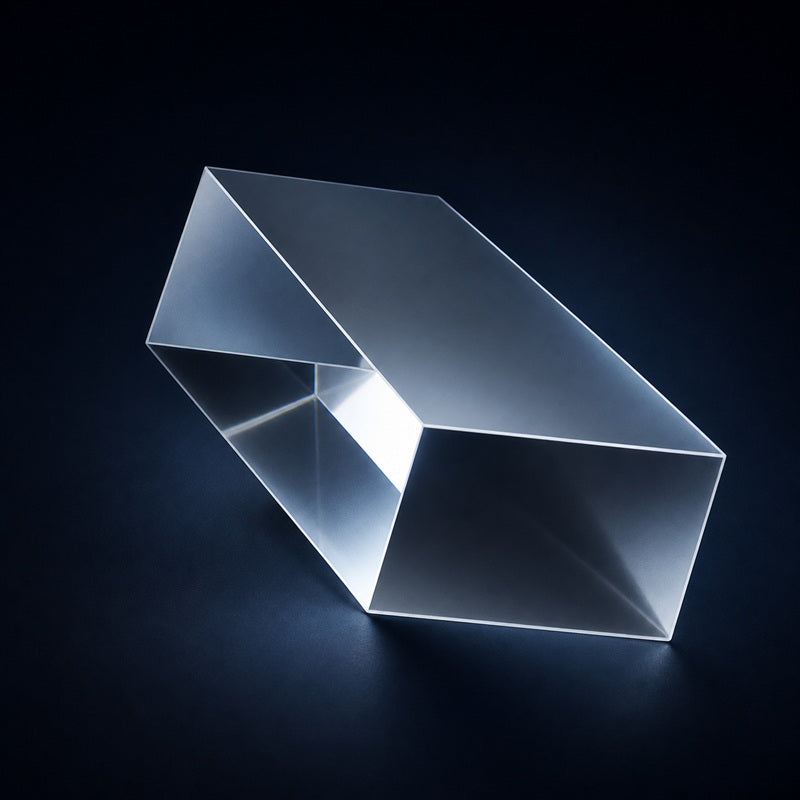

SO-P06 SERIES
SO-P06 Pellin-Broca prisms provide wavelength dispersion with a constant 90-degree beam deviation at the design condition. They are used for harmonic separation, wavelength selection, spectroscopy and laser-line isolation.
Product Overview
Select a Model
models
Engineering Guidance
Choose the Pellin-Broca prism by tuning range and mounting precision
Pellin-Broca vs. equilateral dispersing prisms
Pick Pellin-Broca over an equilateral dispersing prism whenever the output beam direction must stay fixed as wavelength changes — a fixed exit slit, a fixed cavity axis, or a detector that can't be re-aligned every time the wavelength changes. If the downstream optics can rotate together with the prism, an equilateral prism is usually the lower-cost option for the same dispersion task.
Sizing, mounting and material
Match the A and B side lengths and height to the beam diameter and clear-aperture margin, then confirm the prism-angle tolerance against how much deviation drift the application can tolerate. Because wavelength tuning is done by rotating the prism about its vertex axis, the mount's angular resolution — not just the prism's own angle tolerance — sets the practical wavelength-selection precision. K9 covers the visible range at lower cost; UV fused silica is needed once the design wavelength moves into the UV.
Need a different diameter, tolerance or coating?
Custom substrate materials, dimensions, angular tolerances and coating bands can be reviewed for prototype and production quantities.
- Die Auswahl einer Auswahl führt zu einer vollständigen Seitenaktualisierung.