
Optical Mirror Buying Guide: Flat, Concave & Convex Mirrors
An optical mirror reflects light using a coated surface rather than refraction, which makes it useful anywhere a lens's chromatic aberration or transmission loss would get in the way. Choosing the right one comes down to two decisions: what surface shape you need, and what coating will reflect your wavelength efficiently.
Key Specifications at a Glance
| Parameter | Common Options |
|---|---|
| Common substrates | N-BK7, fused silica, metal (aluminum) |
| Surface shapes | Flat, concave (focusing), convex (diverging) |
| Surface flatness/figure | λ/4 (standard), λ/10 (precision) at 633 nm |
| Surface quality | 60-40 to 20-10 scratch-dig, down to 10-5 for demanding laser systems |
| Coating types | Protected/enhanced aluminum, protected silver, protected gold, dielectric |
| Reflectivity | ~90% (basic aluminum) to 99.9%+ (dielectric laser mirrors) |
Choosing a Surface Shape
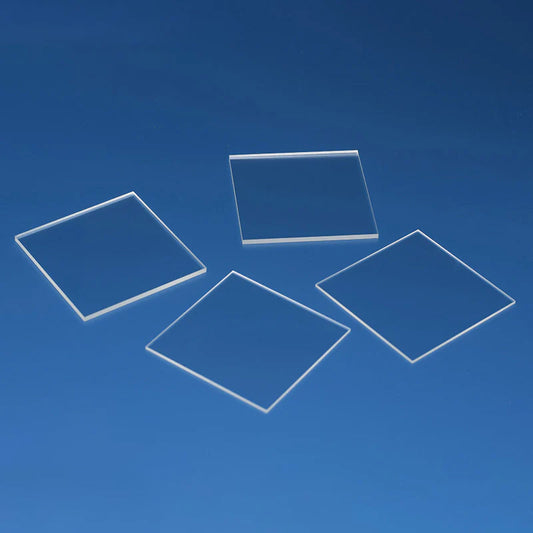
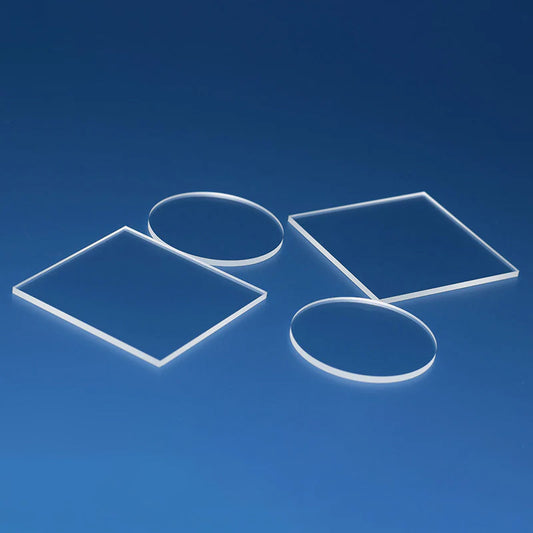
- Flat mirror — redirects a beam without changing its shape or focus; the default choice for beam steering, periscopes, and interferometry
- Concave mirror — curves inward and focuses parallel light to a point; used in telescopes, focusing optics, and any system that needs to concentrate light without chromatic aberration
- Convex mirror — curves outward and diverges light, giving a wider field of view from a compact mirror; used in beam expansion and wide-angle viewing systems
Choosing a Coating
Reflectivity, wavelength range, and laser damage threshold all come from the coating, not the substrate. Broadly:
- Metallic coatings (aluminum, silver, gold) reflect a wide wavelength range and work at any angle of incidence, but reflectivity tops out around 95–98% and the coating is more easily damaged
- Dielectric coatings reach reflectivity above 99% over a defined wavelength band and hold up much better under high laser power, but only work well within the band they're designed for
See our dedicated guide to metallic vs. dielectric mirror coatings for the full comparison.
Applications
- Beam steering and folding in laser and imaging systems
- Telescope and spectrometer optics
- Illumination and projection systems
- Interferometry and metrology
Buying Tips
Match the coating to your actual operating wavelength, not just "visible light" in general — a coating optimized for 400–700 nm can lose several percentage points of reflectivity outside that band. For laser systems, always check the coating's damage threshold against your beam's power density, not just its reflectivity.